


 Key takeaways

You've seen these videos. A hand sketches a stick figure, an arrow, a few words on a whiteboard, while a voice explains something in the background. They show up on YouTube, in Facebook feeds, and at the front of video sales letters. They look like they took a studio a week to make.
They didn't. I made a short one in an afternoon, and most of that afternoon was me second-guessing my script.
This guide walks you through making your own doodle video in Doodly, start to finish. But it does one thing the other "how to make doodle videos" pages skip: it tells you straight whether Doodly is worth your money for your goal, with the rough edges included. Because making the video is the easy part. Deciding if the tool earns a spot in your affiliate toolkit is the part that actually matters.
What a doodle video actually is (and why affiliates bother)
"Doodle video" and "whiteboard animation" are the same thing, mostly. A hand appears to draw your content in real time on a board. An "explainer video" is the job those videos usually do: explain a product, a process, or an idea quickly. So a doodle video is one style of explainer. Don't overthink the labels.
Here's why an affiliate marketer should care. Video is some of the cheapest free traffic left, and a faceless format removes the single biggest reason people never start: not wanting to be on camera. You can build a whole YouTube channel in your niche, never show your face, and send that traffic to a video marketing funnel that ends at your offer or your email list.
This is straight out of the Affilorama playbook. I have taught for years that you don't need a big audience or a personal brand to earn commissions, you need useful content that ranks and converts. Faceless video fits that perfectly. A doodle explainer can rank in YouTube search, sit on a product review page to lift time-on-page, or front a sales video that warms a cold visitor before they hit your buy button.
If you're weighing video against your usual blog posts, both work. We've run Affilorama on written content and lessons for years. But video reaches a different chunk of your audience, and doodle videos are about the lowest-effort way into it. For the bigger picture, see our guide on making video content.
What Doodly is in 2026
Doodly is desktop software (Mac and PC) that builds whiteboard-style animations through drag-and-drop. You pick a board, drop pre-made characters and props onto each scene, type your text, and Doodly animates a hand "drawing" it all. No keyframes, no timeline wizardry like you'd wrestle with in After Effects.
A few things have changed since the old tutorials floating around the web. Doodly is now part of Voomly Cloud, a suite that also includes Toonly (cartoon-style animation), Talkia (text-to-speech voiceover), and a few other tools. So when you sign up today, you're often buying into that bundle rather than a standalone Doodly license. More on what that means for your wallet below.
How it's different from a regular video editor: a normal editor (Premiere, CapCut, DaVinci) assumes you already have footage. Doodly assumes you have nothing and hands you the assets, the hand animation, and the board. You're assembling, not filming. That's the whole appeal, and also the whole limitation.
Before you open Doodly: plan the thing
This is the step most people skip, and it's the one that saved my video. Doodly makes building easy, which is exactly why it's tempting to start dragging stick figures around with no plan and end up with a four-minute mess.
Do three small things first.
- Pick one goal. One. "Get viewers to click my link in the description." "Explain why this supplement beats the popular one." Trying to do two jobs in one video is how you do neither.
- Write a short script. Read it out loud and time it. Roughly 130 to 150 words equals a minute of finished video. If your script runs long, your video will too, and doodle videos lose people fast past the three-minute mark.
- Break the script into scenes. One idea per scene. Next to each line, jot what the viewer should see: a character, a key phrase, a simple icon. This is your storyboard. It can live on a napkin.
Honestly, this is the part most people get wrong, and it has nothing to do with the software. A tight 90-second script with a clear ask beats a gorgeous five-minute video that wanders. For help getting the words right, our notes on recording affiliate videos cover scripting and narration too.

Step-by-step: building your doodle video in Doodly
Step 1: Create a new project
Open Doodly and start a new project. Give it a real name, not "test1," because you'll make more than one.
Step 2: Choose your board
Doodly gives you a few board styles: whiteboard, blackboard (chalk look), glassboard, and a green board. Whiteboard is the safe default and reads best for explainer content. Blackboard feels more "lesson." Pick based on your niche vibe, then move on. This is not a decision worth ten minutes.

Step 3: Build your first scene
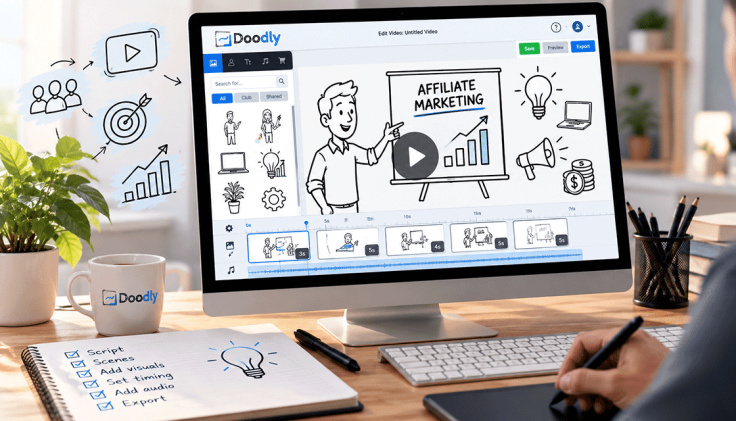
You're now in the editor. Left side: your library of characters, props, text, and sounds. Center: the canvas. Bottom: the scene timeline, where each scene and your audio live. Start by adding text. Click the text icon, choose a font, type your first line. Then add a character: click the characters icon, find one that fits, drop it on the canvas. That's a scene.
Step 4: Add text, characters, and props
Repeat scene by scene, following your storyboard. Props are the small touches that make a scene land, an arrow pointing at your key phrase, a dollar sign, a thumbs-up. Don't crowd the board. Three or four elements per scene is plenty. A doodle video earns attention by being clean, not busy.
Step 5: Set the draw timing
Each element has a draw time (how long the hand takes to sketch it) and each scene has a total duration. This is where pacing lives. If the hand draws too slowly, viewers bail. Too fast, and it feels frantic. Adjust the timing in the bottom-right of each scene until it matches the words you'll narrate over it. You'll tweak this again after you add audio. Everyone does.

Step 6: Add voiceover or music
Two routes. Record narration directly in Doodly while the scenes play, which is the fastest way to sync your voice to the visuals. Or record audio separately (in something like Audacity) and import it. Add a quiet background music track if you want, Doodly includes royalty-free options, but keep it low. The voice is the star.
If recording your own voice makes you wince, the Voomly bundle's Talkia tool does text-to-speech, or you can hire a cheap voice on Fiverr. A clear human voice still beats a robotic one for trust, so use AI narration as a starting point, not the finish line.
Step 7: The part nobody warns you about: imported graphics
Here's where my afternoon got annoying, and where the official tutorials gloss over reality. I wanted my own logo in the video. So I imported a PNG, and Doodly animated it with its default "scribble" effect, a random zigzag motion that made my clean logo look like a toddler attacked it with a crayon.
The fix isn't obvious until you find it: select the image, open the drawing-path editor (the pencil icon, top-right), and manually trace how the hand should draw it, stroke by stroke. It takes a few minutes per image. For a simple logo, worth it. For anything detailed, budget real time or just keep using Doodly's built-in assets, which already animate cleanly. This single quirk is the difference between a video that looks intentional and one that looks broken. Plan for it.

Step 8: Preview, fix, export
Preview the whole thing. Watch for timing drift between voice and visuals (you'll find some). Fix it. Then export. Doodly outputs MP4 and a few other formats, lets you set resolution and frame rate, and, nicely, doesn't stamp a watermark on your finished video. One warning: rendering can be slow, especially at 1080p. Start the export, go make coffee.
That's a finished doodle video. My first usable one ran about 80 seconds and took roughly two hours including the script. The second took 40 minutes. The tool gets fast once the planning becomes a habit.
Doodly features worth knowing
You don't need all of these on day one, but they're the levers you'll reach for as you make more videos:
- Board and hand styles. Multiple boards (whiteboard, blackboard, glass, green) and a big set of hands in different skin tones and styles, so the "drawer" can match your brand or audience.
- Characters, props, and scene templates. Thousands of pre-drawn assets and ready-made scene layouts. This library is the real time-saver, lean on it.
- Custom uploads and draw paths. Import your own PNG, JPEG, or SVG images, then control exactly how they're drawn. Powerful, slightly fiddly (see Step 7).
- Audio and voiceover. Record narration in-app synced to your scenes, plus royalty-free music tracks.
- Export options. MP4 and other formats, adjustable resolution and frame rate, no forced watermark.
How affiliate marketers actually use Doodly
The tool is only as good as the job you point it at. Four jobs that pay off:
A faceless YouTube channel. Publish short doodle explainers on topics in your niche, link to your offer or freebie in the description, and let YouTube search send you free traffic over time. This is the highest-leverage use, and it pairs directly with YouTube affiliate marketing.
Review and comparison videos. Drop a 60-second doodle summary onto a written product review to lift engagement and give skimmers the gist before they read.
Video sales letters. A doodle VSL keeps a cold visitor watching longer than a wall of text, which is exactly what you want right before the call to action.
Lead-magnet and landing-page videos. A short "here's what you'll get" doodle above your opt-in form can lift sign-ups. Small video, real difference.

Doodly pricing in 2026: what to actually check
I'm not going to quote a hard price, because Doodly's pricing has moved around and you'll get burned trusting an old number. Here's the honest state of it as of June 2026, and what to confirm before you pay.
Doodly is now sold as part of the Voomly Cloud subscription, typically billed monthly or annually, rather than the one-time lifetime deals and discount coupons that floated around years ago. Those coupon offers are gone, so ignore any blog promising you a magic code. There's a money-back guarantee (commonly listed at 30 days), which is your real safety net.
Before you buy, check four things on the live pricing page:
- Monthly vs annual cost, and whether the plan you're looking at is standalone Doodly or the full Voomly Cloud bundle.
- What's actually included at your tier. Lower tiers historically limited assets and pushed upgrades, so confirm the character, prop, and export limits.
- The refund window and how to claim it, in writing, before you pay.
- Whether you'll use the bundle. If Toonly and Talkia are useless to you, you're partly paying for shelf-ware.
When it's worth it: you'll publish doodle videos on a regular schedule (weekly YouTube, ongoing VSLs, a content calendar). The subscription divided across 20 videos a year is cheap. When it's not: you need one video for one launch. In that case a freelancer or a free tool will cost you less than a year's subscription.
Doodly pros and cons (the honest version)
What's good:
- Genuinely beginner-friendly. If you can drag a file onto a folder, you can use Doodly. Most reviewers rate ease of use as its strongest feature, and that matches my experience.
- Huge built-in asset library, so you rarely start from a blank board.
- Faceless and fast once you're warmed up. A 40-minute video is realistic.
- No watermark on exports, and flexible output formats. Client-safe and platform-ready.
What's not:
- The style looks dated next to modern motion-graphics tools. It reads "2018 explainer." For some niches that's charming. For others it undercuts you.
- Rendering can be slow, especially at higher resolution.
- Imported custom graphics need manual draw paths or they look messy (Step 7 again).
- It's a recurring subscription bundled with tools you might not want.
- Lower tiers nudge you toward upgrades, so the entry price isn't always the real price.
That's the full picture. No tool the affiliate-marketing crowd recommends is perfect, and pretending otherwise is how people end up disappointed after they pay.
Doodly alternatives, and when each one wins
Doodly isn't the only way to make these. A quick, honest comparison:
| Tool | Best when… | Trade-off |
|---|---|---|
| VideoScribe | You want the closest direct competitor with a similar whiteboard feel and strong import handling | Subscription, comparable learning curve |
| Vyond / Powtoon | You need a more modern, animated, character-driven look | Pricier, steeper learning curve |
| Animaker | You want browser-based animation with templates and a free tier to test | Free tier is limited and watermarked |
| Canva | You already pay for it and need simple animated explainers, not true whiteboard style | Not a real doodle/whiteboard tool |
| Adobe Animate / After Effects | You're a designer who wants total control and a hand-crafted look | Hard. This is the pro path, weeks not hours |
| AI video tools | You want speed and don't care about the doodle aesthetic | Generic look, less control over message |
The pattern: Doodly wins on speed and ease for the doodle look specifically. If you need modern animation, look at Vyond or Powtoon. If you need cheap and one-off, test Animaker's free tier or hire a freelancer. If you need full creative control and have the skills, Adobe is the ceiling, and a lot more work.
FAQs
Yes. It's one of the easier video tools to pick up. Plan to spend your first session learning the editor, then you're off.
Yes, PNG, JPEG, and SVG. Just expect to set a custom drawing path so imported graphics don't animate as a messy scribble.
Yes. Record directly in Doodly synced to your scenes, or import audio you recorded elsewhere. Text-to-speech is available too via the bundle.
Yes, that's the main use case, and exports come without a watermark. Always confirm the current license terms for the assets on Doodly's site before commercial use.
No. You build the video scene by scene. The "automation" is the hand-drawing animation and the asset library, not an AI that writes or assembles the video for you.
For regular output, usually yes, the asset library and no-watermark exports justify it. For a single video, a free tool or freelancer is often the smarter spend.
Yes. It's active and now part of the Voomly Cloud suite. Check the live site for the current plan structure before buying.
The verdict: should you use Doodly?
Buy it if you're going to make faceless video a real part of your traffic strategy: a YouTube channel, ongoing review videos, VSLs you'll actually publish. For that affiliate, Doodly is a fast, friendly, no-watermark way to produce content most of your competitors won't bother making. The dated style is a fair trade for the speed.
Skip it if you need one polished video, or if your niche demands a slick modern look. Use the 30-day guarantee to test it before you commit to a year, make two real videos in that window, and decide on evidence instead of hype.
Whatever you choose, the video is only half the job. It has to point somewhere: an offer, an email opt-in, a site built to convert the traffic you're about to earn. That's the part we live and breathe at Affilorama.
Want the full system behind the traffic? Get 120+ free affiliate marketing lessons, covering content creation, traffic, and turning visitors into commissions. No credit card needed.
Affiliate disclosure: Some links below go to Doodly through our affiliate link. If you buy, Affilorama may earn a commission at no extra cost to you. We only point you toward tools we'd actually use, and you'll find the honest downsides further down this page.
Make $10,000 per month as an affiliate?

Mark Ling


• 9 years ago
Neelam Shah • 9 years ago
Sally C Austin • 9 years ago
I am sure it will pay for itself in no time.
Thanks for negotiating the terrific discount for us, Mark, really appreciate it.
magdldne • 9 years ago
Seth Tyrssen • 9 years ago
Cecille Loorluis • 9 years ago
Pricing information is on the Doodly website:
https://www.affilorama.com/redirect/doodly
You can click on the "Pricing" tab on the top left.
Please let us know if you have further inquiries. All the best!
Linda PetersS • 9 years ago
Like me, you’re probably thinking that to make videos like this you need to be some expert at doodle animation or have the money to hire someone to make them (and this is usually very expensive).I included a video as well as screenshots so you get the fully understand how the whole thing works.
This is very nice post silo because it was added animation with a doll.
Eliza • 8 years ago
Free Jev Online • 16 days ago
Rhea Bontol • 10 days ago